
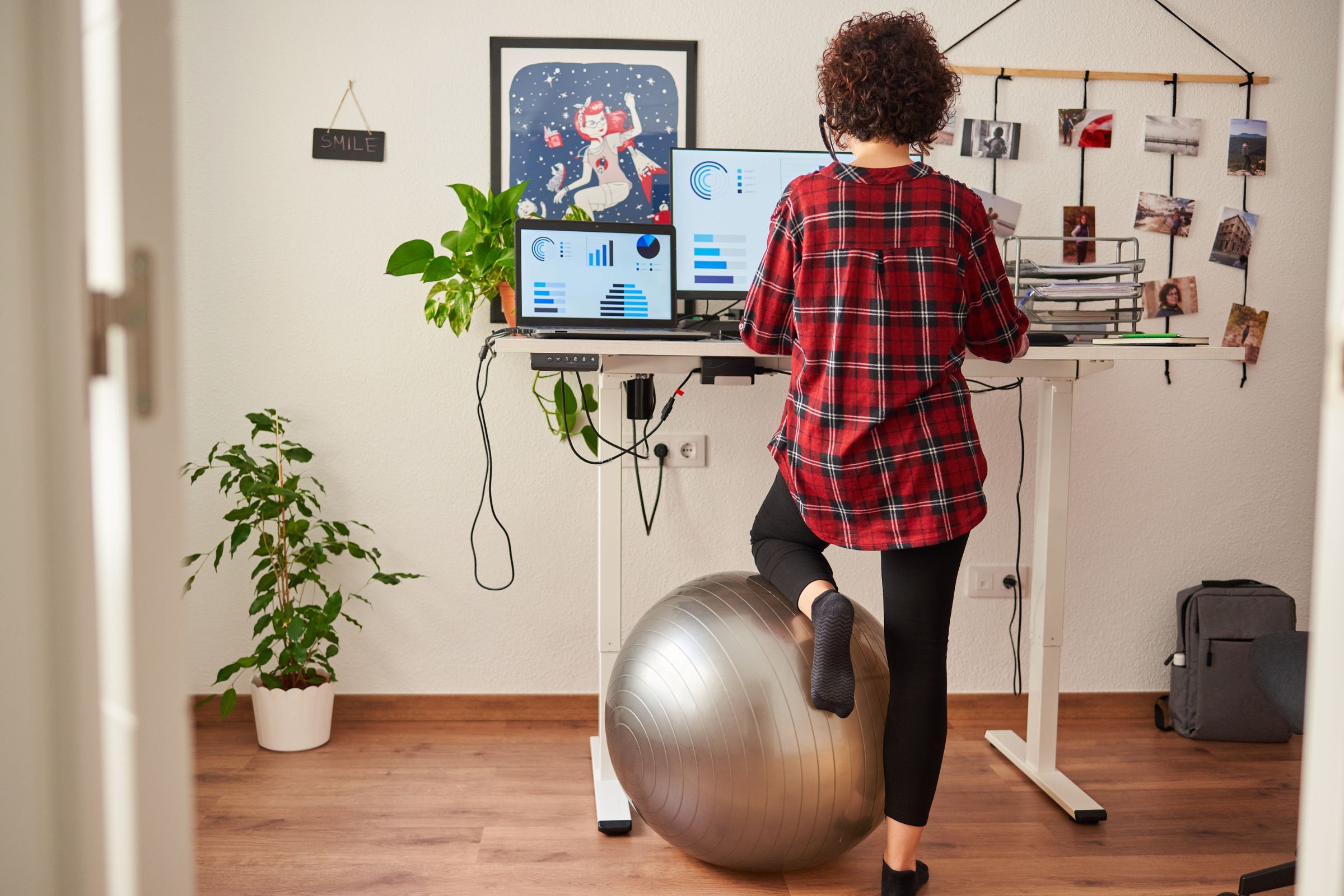
The short answer: when you are standing with your shoulders relaxed and elbows bent at roughly 90 degrees, the top of the desk should sit just under your elbows. For most people that lands somewhere between 36 inches (5'0") and 47 inches (6'5"), but arm length, torso-to-leg ratio, shoes, and floor mats all shift the target by an inch or two. The chart and formula below give you a specific number for your height — not just an angle.
Why standing desk height matters
A desk set too high forces you to shrug your shoulders and angle your wrists up to reach the keyboard, loading the trapezius and the median nerve. A desk set too low pulls you into a forward hunch and rounds your thoracic spine. Both patterns, repeated for hours a day, are the everyday source of the neck, shoulder, and wrist complaints that ergonomists see most often.
The fix is mechanical: get the desk height right and the posture mostly takes care of itself. Flexispot, summarizing anthropometric research, notes that even a couple of centimeters of mismatch noticeably increases shoulder and back strain over a full workday — small numbers, real impact.
Standing desk height chart by user height
Find your height on the left; the middle column is your target standing-desk height with arms hanging at 90 degrees. The right column is the matching seated-desk height — useful if you're sizing a sit-stand desk that has to do both jobs. Values are inches; measure with the shoes you actually work in.
5'0" (152 cm): stand 36–38 in / sit 22–24 in
5'2" (157 cm): stand 37–39 in / sit 22–24 in
5'4" (163 cm): stand 38–40 in / sit 23–25 in
5'6" (168 cm): stand 40–42 in / sit 24–26 in
5'8" (173 cm): stand 41–43 in / sit 25–27 in
5'10" (178 cm): stand 42–44 in / sit 26–28 in
6'0" (183 cm): stand 43–45 in / sit 26–28 in
6'2" (188 cm): stand 45–47 in / sit 27–29 in
6'4" (193 cm): stand 46–48 in / sit 28–30 in
6'5"+ (196 cm): stand 47–49 in / sit 29–31 in
Most quality electric standing desks cover a 22–49 inch range, so almost every body in this chart is within a single desk's travel. The exception is users at the very short or very tall ends, who should check the desk's minimum and maximum spec before buying.
The quick formula: skip the chart
If you'd rather compute your number directly, ergonomic researchers have published a working range as two linear functions of body height in inches:
Minimum standing desk height (in) = 0.4739 × your height (in) − 6.678
Maximum standing desk height (in) = 0.5538 × your height (in) − 9.427
For a 5'10" user (70 inches), the formula gives 26.5 to 29.3 inches at the elbow — add the keyboard-rest allowance of 1–2 inches and you land at the 42–44 inch range from the chart above. The formula is published by Omni Calculator's desk-height tool and matches the anthropometric tables the BTOD ergonomics calculator draws from.
How to measure your desk height at home
If you don't trust a chart against your specific body proportions, measure directly. People with a longer torso relative to their legs can be three or four inches off the chart's prediction.
The elbow method (most accurate)
- Stand against a wall in your usual work shoes, shoulders relaxed, head over hips.
- Let your arms hang straight down, then bend your elbows to 90° with forearms parallel to the floor.
- Measure the distance from the floor to the underside of your elbow. That number is your baseline desk height.
- Add 1–2 inches so your wrists float slightly above the keyboard rather than bending up to reach it.
The book stack method (no tools)
Stack books on a chair next to you until the top of the stack hits the underside of your bent elbow. The stack height is your baseline. Cruder than the elbow method, but a good sanity check before you spend money on a desk.
What the chart leaves out
Shoes change your effective height
Two-inch heels mean your desk needs to sit two inches higher than the chart says. Standard office shoes add about an inch over barefoot. If you alternate between barefoot mornings and shoes in the afternoon, set the desk for the shoes — the small mismatch is more comfortable than the reverse.
Anti-fatigue mats and keyboard trays
Anti-fatigue mats raise you about half an inch to an inch — drop the desk by the same amount. An under-desk keyboard tray pulls the typing surface a couple of inches below the desktop, so you can run the desk slightly higher than the chart suggests and still keep your wrists neutral. Thick wrist rests do the opposite: lower the desk by about half an inch when you add one.
Torso-to-leg ratio
Two people of identical height can land an inch or two apart on the chart. If you're long in the torso for your height, your elbow height when standing is higher than the population average and your desk should be too. The elbow method captures this; a pure height-input calculator does not.
Monitor height: the second adjustment
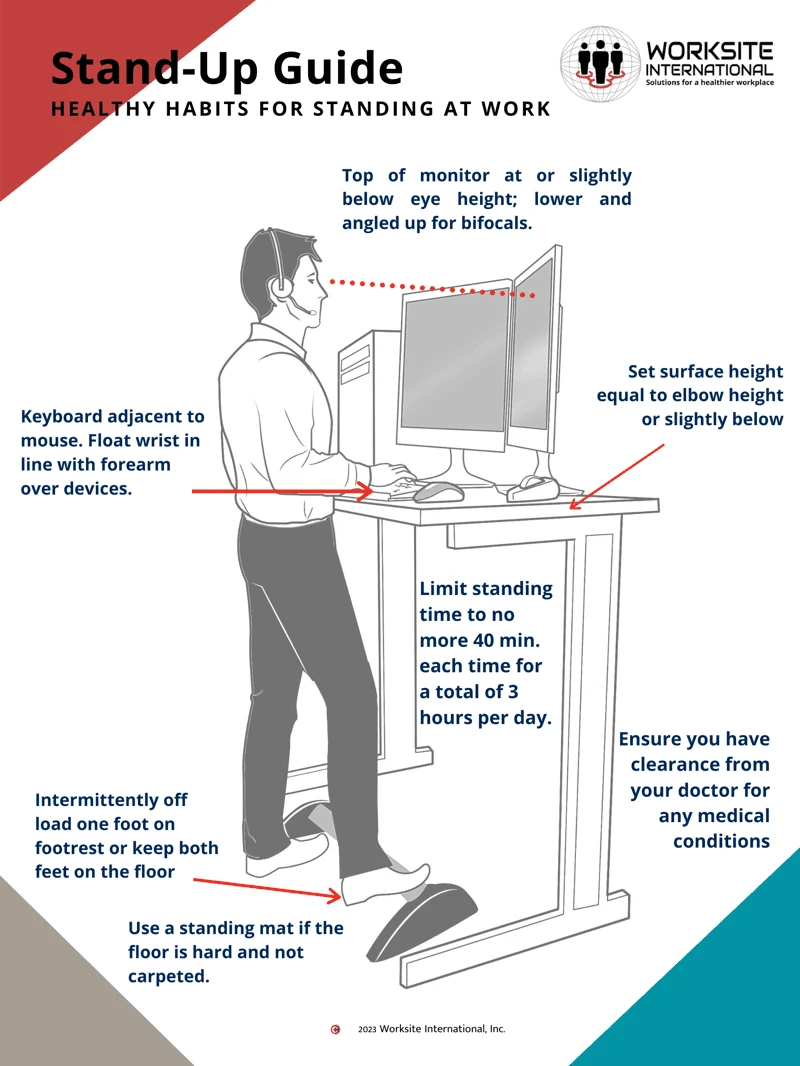
Even a perfect desk height does not fix neck strain from a low monitor. With the desk set correctly, the top third of the screen should land at eye level, and the screen should be about 18–24 inches from your face. If your monitor sits directly on the desktop and you're average height or taller, you'll likely need a monitor arm or a stand to lift it 3–6 inches. Laptop users almost always need either an external monitor or a stand plus an external keyboard — staring down at a screen on the desktop undoes most of the work you just did adjusting the desk.
How to actually use a standing desk once it's set
- Don't stand all day. The current ergonomic consensus is to alternate every 30–60 minutes; standing for eight hours has its own load (varicose veins, foot fatigue) and the goal is movement, not endurance.
- Save two memory presets — one for your standing height with the shoes you wear most, one for your seated height — so you switch with one button press.
- Recheck both heights every six months, or any time you change shoes, add a keyboard tray, or swap your chair.
- If the desk feels right but your shoulders still ache by 3pm, the issue is probably monitor height or keyboard position, not the desk surface.
Standing desk height FAQ
What's the standard standing desk height?
There isn't one — the "standard" 73 cm (about 28.7 inches) desk is sized for someone roughly 5'10" to 6'0" tall and is too tall for typing while standing. Standing-desk height is a function of your specific body height, which is why every desk worth buying is height-adjustable across at least 22 to 48 inches.
What's the right standing desk height for someone 5'10"?
42 to 44 inches with shoes on. The exact number inside that range depends on your shoe thickness, whether you stand on a mat, and your individual torso-to-leg proportions. Use the elbow method to fine-tune within the band.
What's the right standing desk height for someone 6'2"?
45 to 47 inches with shoes on. Make sure the desk you're buying actually reaches that maximum — many electric desks top out around 48 inches, which leaves little headroom if you want a thick desktop or a keyboard tray.
Should my elbows be exactly at 90 degrees?
90 degrees is the baseline, but a slightly obtuse angle (95–100°) is fine and often more comfortable for long typing sessions. The hard rule is that your shoulders stay relaxed and your wrists don't bend upward to reach the keyboard.
Do I need a different desk height for sitting and standing?
Yes — your seated desk height is roughly 14 inches below your standing height for the same elbow geometry. That's the whole point of a sit-stand desk: one surface that moves between the two correct heights for your body.
How often should I recheck my desk height?
At least every six months, and any time you change a variable that affects your standing height: new shoes, a new mat, a keyboard tray, or a different chair for the seated position.