
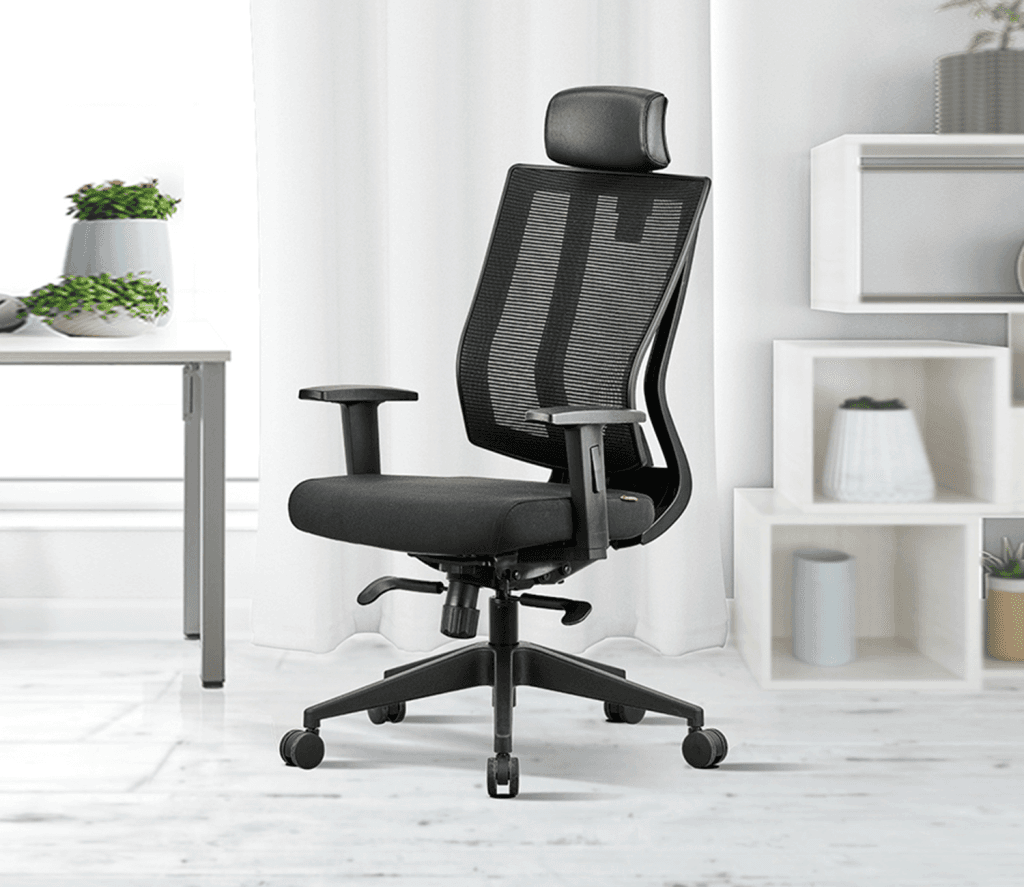
If you can't get your office chair high enough, the cost shows up in your body: knees riding above hip level, shoulders shrugging up toward the desk, wrists kinked over the keyboard. Sitting in a chair that's too short for hours a day is a posture problem first and a comfort problem second.
The good news: most chairs can be made taller, and the right fix depends on where the height shortfall is coming from. Below are seven methods, ordered from "costs nothing" to "costs a new chair" - try them in roughly that order.
Find your target height first
Before you change anything, know what you're aiming for. The Mayo Clinic's office ergonomics guidance recommends that, when seated, your feet rest flat on the floor (or a footrest), your knees sit roughly level with your hips at about 90 degrees, and your forearms are parallel to the floor when typing.
A rough rule of thumb: for a user 5'8"-6'0", the seat pan should land around 17.5-19 inches off the floor; users above 6'0" usually need 18-20+ inches. If your chair tops out below that, the methods below address why.
1. Use the pneumatic lever (the most-missed fix)
Before assuming the chair is broken, confirm you're using the full range. Almost every modern task chair has a paddle under the right side of the seat that controls a pneumatic cylinder.
- Stand up so no weight is on the seat.
- Pull the paddle upward. The cylinder will extend on its own.
- Release the paddle when the seat reaches its top.
If the seat won't hold its height (it slowly sinks under your weight after you sit down), the gas cylinder is worn out and needs to be replaced - see method 3.
2. Swap in taller casters
Standard office-chair casters are 2 to 2.5 inches in diameter. Replacing them with 3-inch or 4-inch heavy-duty casters gains roughly 1 to 1.5 inches of seat height - a small but free-standing win that also helps the chair roll better on rugs.
Most casters use an 11mm stem, which has become the de facto standard, but measure yours before ordering. Tip the chair on its side, grip a caster by the wheel, and pull straight out - they're friction-fit, not threaded.
3. Replace the gas lift cylinder with a longer one
This is the single most effective fix when the lever is fully extended and the seat still sits too low. Stock cylinders typically give 4 to 5 inches of stroke; replacement "tall" cylinders give 5 to 7 inches and add 2 to 4 inches of maximum height.
What to buy: a Class-4 BIFMA-rated pneumatic cylinder with the same diameter as your original (the industry standard is 50mm at the base, tapering to about 28mm at the top). Brand and model rarely matter; matching dimensions matter.
- Flip the chair upside down on a desk or workbench.
- Tap the five-star base off the old cylinder with a rubber mallet (it's wedged on, not bolted).
- Detach the cylinder from the seat's tilt mechanism - sometimes it pulls; sometimes it needs a pipe wrench for leverage.
- Press the new cylinder into the tilt mechanism, then onto the base. Your body weight on the seat seats them tightly.
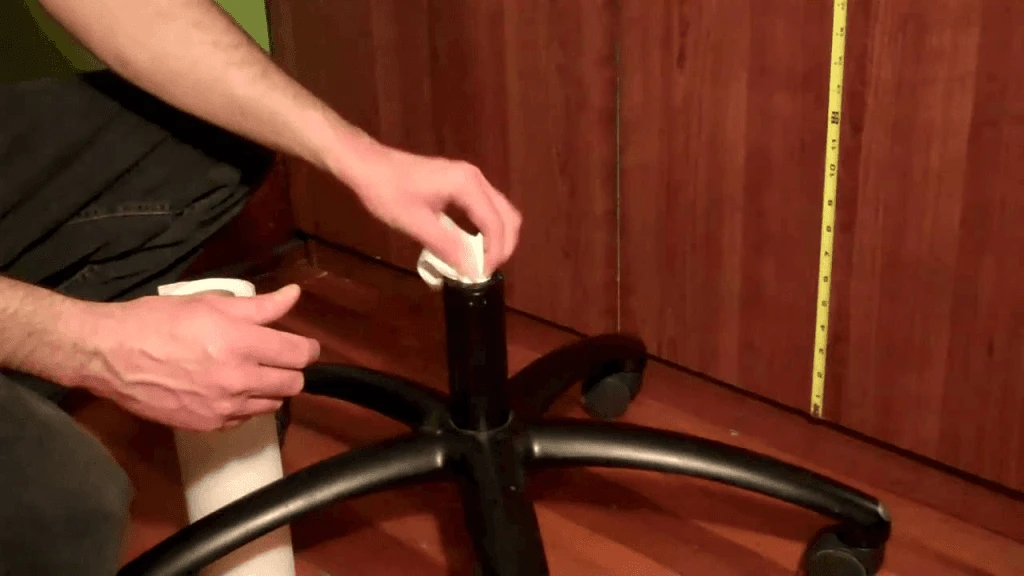
A note on the "paper towels in the cylinder" hack you may see on older guides: it can wedge the cylinder at a fixed height temporarily, but it bypasses the gas lift's safety bleed-off and tends to damage the seal. Don't bother - a $25 replacement cylinder is the right tool.
4. Install a chair height extender kit
Height extender kits are short rigid spacers (typically aluminum or steel) that bolt between the five-star base and the cylinder, adding 2 to 5 inches without changing the chair's mechanism. They're useful when you've already maxed out the cylinder or you don't want to disassemble the seat.
Two cautions before you buy: confirm the kit is rated for your weight (cheap kits often top out at 250 lbs), and accept that adding inches above the base raises the chair's tipping risk slightly - keep the base wide and the casters locked when getting in and out.
5. Add a firm seat cushion
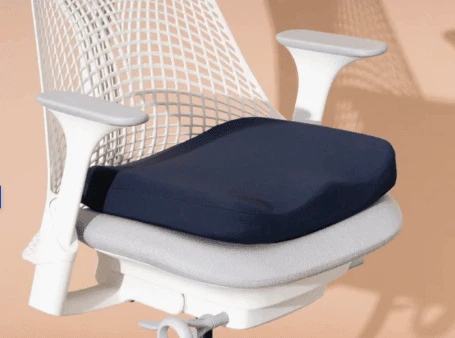
A high-density memory-foam or gel cushion adds 1 to 3 inches without any disassembly. It's the right call when you only need a small boost, when the chair belongs to an employer, or when you want a quick test before committing to a hardware change.
Pick a firm cushion, not a soft one. A soft cushion compresses under your weight and gives back most of the height you thought you'd gained, and the squish forces your hips to hunt for stability all day. Look for high-density foam (≥ 50 kg/m³) or a wedge designed for posture, and use a non-slip backing so the cushion doesn't slide forward.
6. Use a footrest (and lower the desk fix the right way)
Counterintuitively: if your desk is too high, raising the chair to match means your feet leave the floor - which is its own ergonomic problem (cuts off circulation behind the knee, drops the work onto your hamstrings). The cleaner fix is to raise the chair to the right height for your arms, then add a footrest so your feet land flat.
A footrest is also the right answer in shared workstations where you can't make permanent modifications, and for shorter users on chairs that don't go low enough.
7. Replace the chair (when it's worth it)
Most stock task chairs are sized for a 50th-percentile user (roughly 5'4"-5'10"). If you're consistently above that, a chair built for tall users - with a 19+ inch seat range, taller backrest, and deeper seat pan - solves more problems than any combination of fixes above. Look for chairs that explicitly list a seat-height range (Herman Miller Aeron Size C, Steelcase Leap Plus, and Branch Ergonomic Pro Tall are common picks).
Don't replace a chair just to fix height if the rest of it works. A $25 cylinder swap is the right answer if your existing chair is comfortable and well-built; a new chair is the right answer when the seat pan is also too shallow, the lumbar curve hits the wrong spot, or the armrests don't go high enough.
Common questions about raising an office chair
How tall should an office chair be?
Seat height should let your feet rest flat on the floor (or a footrest) with your knees at roughly 90 degrees and your hips level with - or slightly above - your knees. For most adults that lands between 16 and 21 inches off the floor; taller users need the upper end of that range.
Can I raise a chair that has no lever?
Yes. Chairs without a pneumatic lever are usually height-fixed by a threaded screw mechanism or simply non-adjustable. The non-mechanical options still work: taller casters, an extender kit, a firm seat cushion, or wooden risers under the base for non-wheeled chairs.
Why does my office chair keep sinking?
The gas cylinder's seal has failed and it can no longer hold pressure under your weight. There's no repair - the cylinder needs to be replaced. A new BIFMA Class-4 cylinder typically runs $20-$40 and takes 15 minutes to swap.
Are chair height extender kits safe?
They're safe within their weight rating, but every inch you add raises the chair's center of gravity and slightly increases tip-over risk. Buy a kit rated above your body weight, install it on a chair with a wide five-star base, and don't combine multiple extenders.
Will raising my chair fix back pain?
Sometimes - chair height that's too low forces hip flexion past 90 degrees and rounds the lumbar spine, which is a common back-pain driver. But back pain has many causes; raising the chair is one of several adjustments (lumbar support, monitor height, breaks) to try together. If pain persists, see a clinician.
The short version
Start with the lever you already have. If it's maxed and you're still too low, replace the gas cylinder - it's cheap, fast, and addresses the actual mechanism. Casters, cushions, and extender kits are useful add-ons for the last inch or two. A new chair is the right call when the height problem is one of several things wrong with what you're sitting in.