
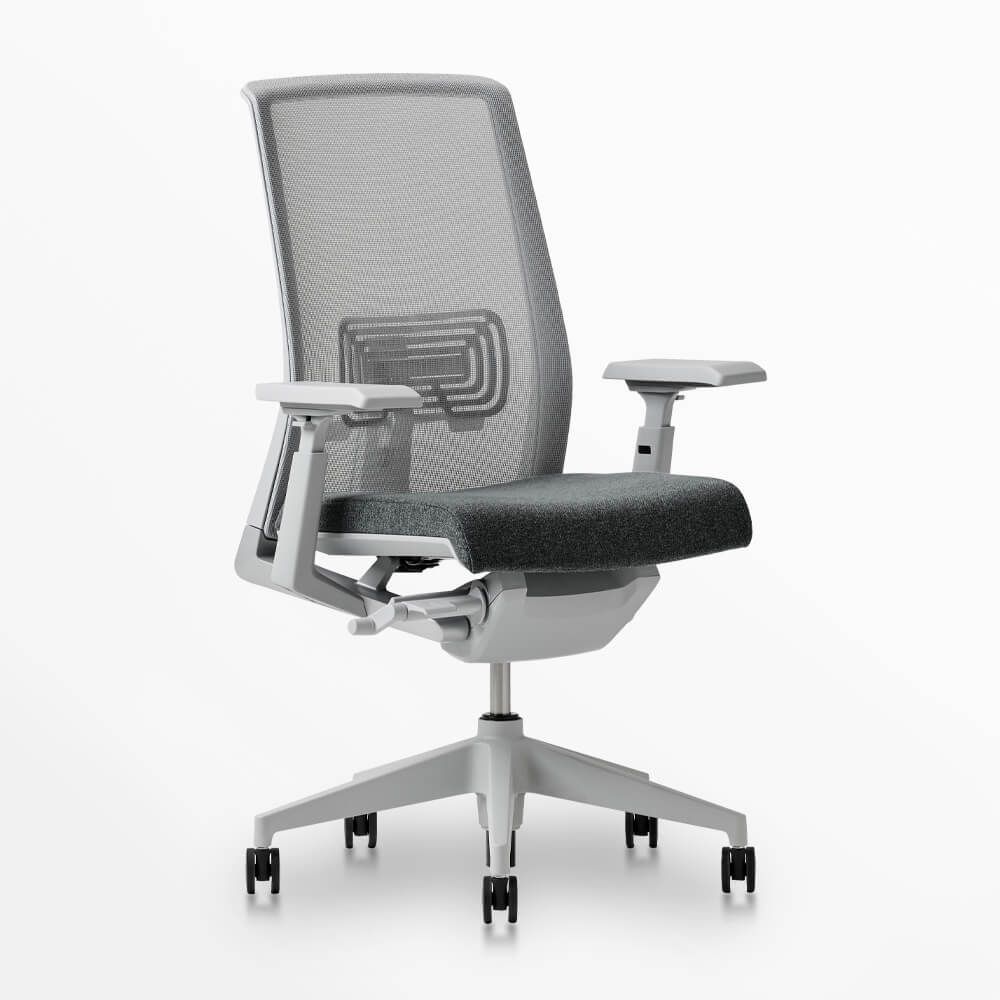
A "task chair" and an "ergonomic chair" are not the same thing, even though showrooms and product listings often blur the line. The short version: a task chair is a category defined by how the chair is used (short bursts of focused desk work), while an ergonomic chair is defined by what it can do (adjust to support a specific body across long sessions). A chair can be both - but most task chairs are not.
If you sit for 6+ hours a day, the difference shapes whether you finish the day comfortable or sore. Here is how to tell them apart, when each one is the right call, and what to actually look for before you buy.
What is a task chair?
A task chair is a compact, swivel office chair built for shorter, focused work - checking email, taking a meeting, signing paperwork at a shared workstation. The defining features are practical, not therapeutic:
- Height adjustment (pneumatic lift)
- Swivel base with casters
- A simple back rest, often without independent lumbar adjustment
- Sometimes fixed or 1D armrests
Task chairs prioritize footprint and price over long-session support. They typically run $50 to $300, and the bottom of that range is everywhere - hot-desks, reception areas, conference rooms, secondary home-office setups.
What they are not designed for: eight straight hours of deep work. The seat pan is usually a fixed depth, the back rest often lacks tilt-lock, and lumbar support - if it exists at all - is a sculpted shape rather than something you can adjust.
What is an ergonomic chair?
An ergonomic chair is engineered to fit a specific body over long sitting durations. The starting question is different - not "is there a chair here?" but "does this chair adjust to you?" The hallmark features:
- Adjustable lumbar support (height and depth, not just a fixed bump)
- Seat depth (slide) adjustment so the seat pan fits your femur length
- Multi-axis (3D or 4D) armrests - height, width, depth, pivot
- Synchronous or independent recline tilt with tension and lock
- Adjustable headrest on higher-end models
- Breathable seat and back materials (mesh, performance fabric) for heat management
Pricing reflects the engineering: entry-level ergonomic chairs start around $400, mid-range sits at $700 to $1,200, and premium task-grade ergonomic chairs like the Herman Miller Aeron or Steelcase Leap run $1,400 to $1,800+.
The point of all that adjustment is not luxury - it is prevention. The Mayo Clinic and ergonomics researchers tie sustained poor seated posture to lower-back pain, neck strain, and repetitive-stress injuries; a chair that adjusts to keep the spine in its natural S-curve removes a major risk factor.
Task chair vs ergonomic chair: side-by-side
A useful way to think about it: a task chair is sized to a task; an ergonomic chair is sized to a person. The differences cluster around adjustability, materials, and how long the chair is expected to last.
Task chair vs ergonomic chair at a glance
| Product | Best for | Firmness |
|---|---|---|
| 1Designed forUse case | Short bursts vs long sessions | 50 |
| 2Lumbar supportAdjustment | Fixed shape vs height + depth | 50 |
| 3Seat depthAdjustment | Fixed vs slide adjustable | 50 |
| 4ArmrestsAdjustment | None or 1D vs 3D / 4D | 50 |
| 5ReclineMechanism | Tilt-back vs synchronous tilt with lock | 50 |
| 6MaterialsBuild | Foam and fabric vs mesh / performance foam | 50 |
| 7Price bandCost | $50 to $300 vs $400 to $1,800+ | 50 |
| 8Typical lifespanDurability | 2 to 5 years vs 10 to 12 years warrantied | 50 |
When a task chair is the right pick
Task chairs are not "bad chairs" - they are the right tool for the right job. Pick a task chair if:
- You sit at the desk fewer than 4 hours a day, or in short bursts between standing or walking.
- The seat is shared (huddle room, hot-desk, reception).
- Budget is the hard constraint and the alternative is a folding chair.
- You already have a primary ergonomic chair elsewhere and need a secondary station (kitchen island, kid's homework desk).
Look for at least these three features even on a budget task chair: pneumatic height, a back rest with some lumbar contour, and casters rated for your floor. A $99 task chair with all three is a defensible buy; a $99 chair with none is a back-pain delivery service.
When an ergonomic chair is worth the spend
Pick an ergonomic chair if any of the following are true:
- You sit 6+ hours a day, especially as a knowledge worker or creator.
- You have existing back, neck, or hip discomfort - or a clinician has flagged posture as a contributing factor.
- You are tall (6'2"+) or petite (under 5'4") - the adjustability range of a true ergonomic chair is what makes the chair fit your frame at all.
- You work from home and the chair is your primary daily workstation.
The math is less brutal than it looks. A $1,000 ergonomic chair with a 12-year warranty costs about $83 per year - less than most monthly streaming bundles, and unlike the streaming bundle, it pays back in spine health.
What about hybrid "ergonomic task chairs"?
The category is real and growing. An ergonomic task chair typically means: the compact footprint of a task chair, plus some (not all) ergonomic adjustments - usually height + adjustable lumbar + at least 2D armrests. Examples sit in the $300 to $600 band.
This hybrid is the sweet spot for: small home offices, second workstations, students, and anyone who wants better support than a $150 task chair gives without committing to a flagship ergonomic chair.
What you give up vs. a full ergonomic chair: seat-depth slide (often), 4D armrests, fine-tuned recline tension, premium mesh, and the long warranty.
What to check before you buy
Whichever side of the line you land on, the same five questions apply.
- Does the seat pan slide? Without seat-depth adjustment, taller users get cut off behind the knees and shorter users can't reach the lumbar curve. This is the single most under-appreciated feature.
- Is the lumbar adjustable, not just shaped? A sculpted "lumbar zone" only fits the spine it was sculpted for. A height- and depth-adjustable lumbar pad fits yours.
- Do the armrests move in 3+ directions? Up/down is table stakes. Width and pivot let the armrests support typing posture instead of just elbow weight.
- Does the back tilt with tension control? "Recline" without tension is a fall hazard; with a tension dial you can match the recline to your body weight.
- What is the warranty, in years and on which parts? A 12-year full-mechanism warranty signals a chair built to last; a 1-year "limited" warranty signals a chair built to a price.
Task chair pros
- Affordable; entry-level models start under $100
- Compact footprint suits small or shared workstations
- Plug-and-play; no fitting session required
- Right tool for short, focused desk bursts
Task chair cons
- Limited or no adjustable lumbar support
- Seat pan is usually fixed depth; poor fit for tall or petite users
- Armrests rarely adjust beyond up-down
- Shorter lifespan; 2 to 5 year typical replacement cycle
Ergonomic chair pros
- Adjusts to your specific body across long sessions
- Supports the spine's natural S-curve to reduce back and neck strain
- 3D or 4D armrests support typing posture, not just elbow weight
- 10 to 12 year warranties are common on flagship models
Ergonomic chair cons
- Higher entry price; credible options start around $400
- Initial fitting takes a few minutes to dial in correctly
- Larger footprint than a basic task chair
- Diminishing returns above the $1,200 to $1,500 band
Frequently asked questions
Is every ergonomic chair also a task chair?
Not quite. 'Task chair' is a form-factor and use-case category (compact, swivel, casters, intended for desk tasks). Many ergonomic chairs fit that form factor, but executive ergonomic chairs and dedicated drafting stools do not.
Do I need an ergonomic chair if I don't have back pain?
Prevention is cheaper than rehab. If you sit 6+ hours a day, an adjustable chair lowers the odds of developing pain in the first place. Mayo Clinic and most occupational-therapy guidance frame ergonomics as a long-game investment, not a fix-it-later one.
Can I just add a lumbar pillow to a task chair?
A strap-on lumbar cushion is a real improvement for an otherwise non-adjustable chair, and it is the cheapest upgrade you can make. It does not substitute for seat-depth adjustment, proper armrest geometry, or recline tension.
What is the cheapest credible ergonomic chair?
Entry-level ergonomic chairs from established makers (FlexiSpot, Branch, Autonomous) start around $300 to $400 and include the core adjustments: height, adjustable lumbar, 2D+ armrests, basic recline. Below that, you are buying a task chair with marketing copy.
Are mesh-back chairs always better?
Mesh runs cooler and shows pressure points the maker had to engineer around, which is a positive signal. But a well-built foam-and-fabric ergonomic chair (Steelcase Leap, Humanscale Freedom) is not 'worse' - it is a different comfort profile. Personal preference wins here.