
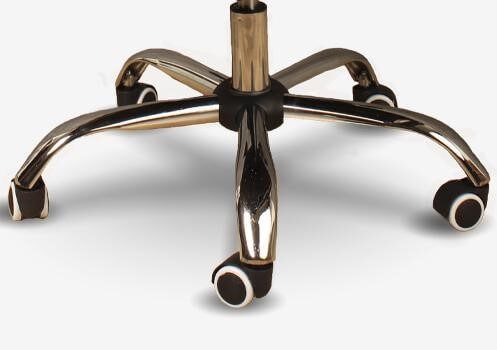
Office chair casters take a brutal amount of abuse - body weight, hair, dust, the occasional rolled-over power cord. When they start dragging, squeaking, or refusing to swivel, replacing them is one of the cheapest ergonomic upgrades you can make. The hard part isn't the install. It's getting the old casters out.
This guide walks through the two caster stem types you'll encounter, six removal steps that cover both, and what to do when a caster is genuinely stuck.
When to replace your office chair casters
Five signs the casters - not the chair - are the problem:
- Damaged or flat-spotted wheels. The most obvious failure. Heavy users and repeated impact (rolling over thresholds, cables) wear the polyurethane tread unevenly.
- Corroded housings or stems. Rust on the stem is a safety issue - the caster can shear off under load.
- Deformed wheels. Prolonged static pressure (chair left in one spot for months) creates permanent flat spots that no lubrication fixes.
- Persistent noise. Squeaks usually mean failed ball bearings or hair wrapped around the axle.
- Resistance when pushing. If the chair won't roll smoothly even on clean hard floor, the casters are spent.
Identify your caster stem type first
Before you pull anything, look at one of the casters. The removal technique depends on which of two stem types your chair uses:
- Grip-ring stem (most common). A smooth metal post with a small spring-loaded ring near the top. Held in by friction - pulls straight out.
- Threaded stem (rare on task chairs, common on industrial seating). Visible spiral threads. Unscrews like a bolt.
If you can see threads, follow the threaded-caster step. If the post is smooth, follow the grip-stem step.
How to remove casters from an office chair
Step 1: Flip the chair over
Lay the chair on its back or upside down on a flat, padded surface so the casters point up. A towel or rug protects both the chair's back and the floor. Working from underneath is awkward; flipping it makes every following step easier.
Step 2: Twist threaded casters counterclockwise
For threaded stems, grip the wheel firmly and rotate counterclockwise (the same direction you'd unscrew a jar lid). It usually backs out within a few turns. If it spins freely without backing out, the stem may be seized - apply a drop of penetrating oil to the joint and let it sit five minutes before retrying.
Step 3: Pull grip-stem casters straight out
Grip-stem casters are held by a small ring inside the chair leg. Hold the chair base steady with one hand. Wrap the wheel with the other (a folded towel helps your grip), then pull straight out - no twisting. Most pop free with one firm tug. If yours fights back, apply a few drops of penetrating oil or soapy water around the stem-leg joint and try again.
Step 4: Bring out the screwdriver and pry bar
For casters that won't budge by hand, you need leverage. A flat-head screwdriver (roughly 13 mm / half-inch tip) and a small pry bar with a nail-pulling notch are the standard combination. Some users prefer a claw hammer - same principle.
Step 5: Wedge the screwdriver between base and caster
Insert the screwdriver tip between the chair base and the top of the caster housing. Gently lever the caster downward, working around the stem if needed. The goal is to widen the gap so the pry bar can grab the stem itself - not to snap the base.
Step 6: Pop the caster out with the pry bar
Slide the pry bar's notch around the stem, brace it against the base, and lever the caster out. The retention ring will release with a small pop. Repeat for the remaining four casters.
When a caster still won't come out
If the steps above fail, the stem itself is likely rusted into the leg socket. Three escalating fixes:
- Saturate the joint with penetrating oil (WD-40, PB Blaster) and wait 15-30 minutes. Reapply once.
- Clamp locking pliers (vise grips) directly onto the stem above the wheel, then tap the pliers downward with a rubber mallet to break the rust bond.
- If the wheel separates from the stem mid-pull, clamp the bare stem with vise grips and continue with the mallet method. The stem must come out; you can't seat a new caster into an occupied socket.
Reinstalling new casters
Before buying replacements, measure the stem: most office chairs use a 7/16-inch diameter, 7/8-inch length grip-ring stem, but verify yours - industrial chairs vary.
Installation is fast: clean any debris from the leg socket, align the new stem, and push straight in with steady pressure. The grip ring snaps audibly when it seats. If it resists, a soft tap with a rubber mallet on the top of the caster housing usually does it - never hit the wheel itself.
For threaded casters, thread clockwise by hand until snug. No tools needed and no overtightening - finger-tight is correct.
Quick floor-type buying note
If you're already swapping casters, match them to your floor: soft polyurethane (often labeled "hardwood" or "rollerblade-style") for hard floors, standard nylon for carpet. Mixing the wrong type either scratches the floor or buries the chair in pile.
Frequently asked questions
Can all office chair casters be removed?
Yes. Every standard office chair caster is designed to be replaceable. Grip-stem casters pull out; threaded casters unscrew. If one feels permanent, it's almost always rust or a stuck retention ring - not a chair that was built without removable wheels.
How are office chair caster wheels attached?
Two methods. Grip-stem casters use a smooth metal post with a small spring-loaded ring that catches inside the chair leg socket - friction holds them in. Threaded casters use a bolt-style stem that screws into a matching socket. Both are held by the chair leg itself, not by any external screw or clip.
Do I need to remove casters to clean them?
Yes, for a real clean. You can snip visible hair off in place, but built-up grime around the axle requires popping the caster out - and on twin-wheel designs, prying the wheel halves apart with a flathead screwdriver to reach the axle.
Why won't my office chair caster come out?
Either rust in the stem-to-socket joint or a retention ring that's seized to the leg wall. Apply penetrating oil, wait 15 minutes, and use locking pliers plus a rubber mallet for leverage. Pulling harder by hand rarely works once a caster is truly stuck.
Are all office chair casters the same size?
No. The most common stem is 7/16-inch diameter by 7/8-inch length, but industrial, gaming, and some European chairs use different dimensions. Always measure your existing stem before ordering replacements.