
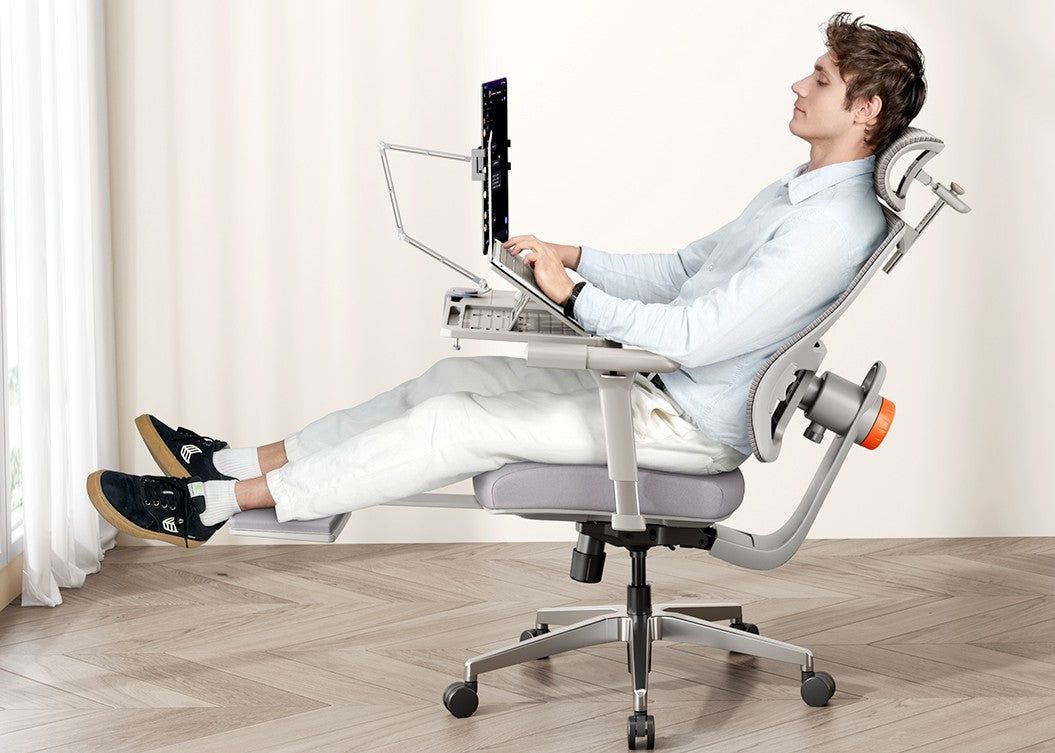
A wobbly office chair is the kind of low-grade annoyance that quietly erodes a working day. It pulls your attention out of deep work, nudges you into compensatory posture, and - if you let it slide - usually escalates into a more expensive failure. The good news: in the vast majority of cases, an unstable chair is a cheap, 20-minute fix you can do at your desk with a hex key. The rare exceptions (cracked plastic base, blown gas cylinder) are clearly identifiable once you know what to look for.
This guide walks the chair from the floor up - the order a furniture technician would use - so you spend zero time tightening parts that aren't the problem.
Before you touch the chair: rule out the floor
The single most common false alarm is an uneven floor. Hardwood seams, warped laminate, a thin patch of carpet under one caster - any of these will mimic a structural wobble.
The 30-second test. Roll the chair to a different spot in the room, ideally onto a known-flat surface (a rigid chair mat, a tile floor, a low-pile rug pulled tight). Sit down and rock side-to-side. If the wobble vanishes, the floor was the problem. A glass or polycarbonate chair mat solves it permanently and protects the floor from caster wear at the same time.
If the wobble travels with the chair, the issue is in the chair itself. Work the diagnostic checklist below in order.
The ground-up diagnostic: where the wobble actually lives
Flip the chair upside down on a desk or table so you can see the underside clearly. You'll work through four zones from floor to seat: casters, base, gas cylinder, and the control mechanism / seat pan.
1. Casters (the wheels)
The casters touch the floor first, so any worn bearing or bent stem here shows up as wobble immediately.
- Spin each caster by hand. It should rotate smoothly with no grinding.
- Wiggle each caster sideways at the stem. A small amount of play is normal; anything you can feel as a knock is not.
- Look for cracks in the wheel itself, especially on hard plastic casters.
- Pull hair, thread, and lint out of the axle - this is the single most common silent killer of caster smoothness.
Fix: Replace casters as a complete set, not one at a time. Mixing a new caster with five worn ones leaves the chair tilted and rolling unevenly. Standard office chair casters use an 11mm (7/16") grip-ring stem; some IKEA chairs use 10mm. Measure your existing stem before ordering.
2. The five-star base
The base carries your entire bodyweight every time you sit, stand, or lean. According to BIFMA furniture safety guidance, the base is the load-bearing component most worth treating as a hard-no when damaged.
- Look closely along each of the five legs for hairline cracks.
- On metal bases, cracks tend to show near the central hub or at weld points.
- On plastic bases, cracks are usually obvious and often run along the underside of a leg.
Fix: A cracked plastic base is a replace-now situation. Do not glue it, tape it, or hope. A cracked base is the failure mode behind most viral "office chair collapsed" stories - the chair gives way at full load with no warning. Metal hairline cracks aren't immediately catastrophic but are a definite signal that the base is at end of life.
3. The gas lift cylinder
The cylinder is the vertical column that adjusts seat height. It also handles small rotational and tilt loads, so wobble can originate at either end of it.
- Sit in the chair, plant your feet, and twist the seat side-to-side without rotating the base. A clicking or shifting sensation usually means the cylinder is moving relative to the mechanism above it.
- Lift the chair off the floor and try to spin the base independently of the cylinder. If the base moves freely, the retaining clip or splines at the bottom of the cylinder are worn.
Fix: Often the cylinder is fine and the retaining clip is the cheap part that has failed - a few dollars and five minutes of work. If the cylinder itself has failed (sinking, hissing, oily residue), replace the whole unit. Standard cylinders are 50mm (2") outer diameter at the base end and 28mm (1.1") at the mechanism end; verify stroke length and piston retainer style against your existing part.
4. The control mechanism and seat pan
This is the metal housing bolted to the underside of the seat that holds the tilt, height, and lock levers. It is also, by a wide margin, the most common source of wobble - and the easiest fix.
- Locate the four bolts (usually hex/Allen) attaching the mechanism to the seat pan.
- Try to wiggle the seat relative to the mechanism. Any play here means at least one bolt is loose.
Fix: Tighten the bolts in a star or "X" pattern - quarter-turn on bolt one, then to the opposite, then around - the same way you'd torque a car wheel. Even pressure prevents the mechanism from going slightly off-axis. Stop when bolts are firmly snug; over-tightening strips the threads in the seat pan, which is a much larger problem to fix. For bolts that loosen repeatedly, a single drop of removable (blue) threadlocker on the threads ends the cycle without committing you to a permanent bond.
Critical safety warning before you remove a gas cylinder
Pressurized gas cylinders are not a DIY repair beyond unbolting and swapping them out as a whole unit. Never puncture, heat, cut, or attempt to disassemble a gas cylinder. They can release stored pressure with enough force to cause serious injury. If a cylinder is seized and needs more than a rubber mallet and a few minutes of penetrating oil to free, stop and pay a furniture repair shop the small fee to handle it. This is the one repair on this list where the cost-benefit very clearly favors a professional.
Tool kit for the fixes above
Tighten control-mechanism bolts. Primary: hex key set (3-6mm). Optional: removable threadlocker.
Replace casters. Primary: none - most pull out by hand. Optional: flathead screwdriver wrapped in cloth.
Replace gas cylinder. Primary: rubber mallet. Optional: penetrating oil, pipe wrench (note: a pipe wrench destroys the old cylinder, so reserve it for parts you're already replacing).
Replace base. Primary: rubber mallet. Optional: two-arm bearing puller for stuck cylinders.
Tighten swivel/tilt assembly. Primary: hex key set. Optional: silicone lubricant spray.
Skip cordless drills for any chair repair. They make it far too easy to overtighten and strip the threads in the seat pan, which turns a five-minute fix into a base-replacement project.
How to re-torque after the fix
A pattern furniture technicians see constantly: a fix lasts a week and then loosens again. The cause is almost never the threadlocker - it's that hardware "settles" into its final seat after a few days of normal use. Build the re-check into your calendar:
- Tighten everything snug + a quarter-turn (not maximum force).
- After about one week of normal use, re-check every bolt you touched. Expect at least one to take another quarter-turn. This is normal.
- Re-check again at one month. If bolts are holding, you're done. If they're still loosening, add a drop of removable threadlocker on each.
Component replacement, step by step
Replacing casters
Lay the chair on its side. Grip a caster firmly and pull straight out - most are held in by a grip ring and will release with steady force. If one is stuck, slip a cloth-wrapped flathead screwdriver between the caster and the base and lever gently. Press the new caster straight in until you feel the grip ring click. Do all five (or six) at once.
Replacing the gas cylinder
This is the most physical of the repairs. Detach the base first: flip the chair upside down, and strike the base near the central hub with a rubber mallet until it pops off the cylinder. To free the cylinder from the control mechanism above, strike the bottom of the cylinder (now pointing up) with the same mallet. For stubborn cylinders, apply penetrating oil at both joints and wait 15 minutes. A pipe wrench can grip and twist it out as a last resort - note that it will permanently score and destroy the old cylinder, so only use it when you've already committed to replacement.
Replacing the base
Same removal as above, but with the base as the target part instead of the cylinder. Bases are the easiest replacement of all - once the cylinder is out, the new base just press-fits on. Strike it down onto the cylinder with the mallet until it seats fully.
What you can skip, and what you can't
The internet is full of "office chair hacks" that don't survive a week of real use:
- Wrapping the cylinder with electrical or PTFE tape to take up play. Works for about four days. The friction fit failure is a signal to replace the retaining clip or the cylinder itself.
- Tightening past snug "to be safe." Strips threads in the seat pan and turns a $0 fix into a base-replacement.
- Gluing a cracked plastic base. Glue cannot restore the structural integrity of a load-bearing polymer part. The base will fail again, usually under full load.
- Ignoring the wobble because "it's minor." A chair that wobbles forces your core to micro-correct continuously; over a working day that produces real fatigue and posture compensation. Worth fixing on the day you notice.
What's actually worth doing:
- Tighten all hardware on a new chair at the 1-week mark - assembly bolts settle.
- Vacuum or pick hair out of casters every few months. Most "wobbly caster" complaints are actually "caster bearing locked up with hair."
- Keep the chair on a rigid mat if you use it on uneven flooring or low-pile carpet - saves both the chair and the floor.
When to stop fixing and start shopping
If you've worked the diagnostic and the chair still wobbles after every component has been tightened, lubricated, or replaced, the chair has reached end of life. Two signals it's time to budget for a replacement rather than another part:
- More than two major components (base, cylinder, mechanism) have failed in the same 12-month window.
- The chair is more than 8-10 years old and parts are no longer manufacturer-supported.
In either case, a replacement ergonomic chair is usually cheaper than another round of parts plus the labor cost of your own time. A chair you trust completely is also the most under-rated productivity upgrade on a home-office budget.
Wobbly office chair: quick answers
Is a slight wobble in my office chair normal?
No. Any wobble you can feel forces your core to constantly micro-correct, which produces real fatigue and posture compensation over a working day. It's also a leading indicator of a loose seat-pan bolt or a worn caster - both of which get worse if left. Tighten what's loose now; it's almost always a five-minute fix.
Why does my office chair wobble side to side specifically?
Side-to-side wobble (rather than front-to-back) usually traces back to the gas cylinder's connection points or the four bolts that attach the control mechanism to the seat pan. Flip the chair, try to wiggle the seat against the mechanism - if there's play, those bolts are loose. If the seat feels solid but the whole chair shifts when you twist, the cylinder retainer clip is the next suspect.
Can I tighten the gas cylinder itself?
No - gas cylinders are sealed, pressurized units and aren't user-serviceable. Never puncture, heat, or try to disassemble one. What you can tighten is the retaining clip at the bottom of the cylinder and the bolts at the mechanism above it. If the cylinder itself has failed (sinking, hissing, oil leaks), replace the whole unit.
Should I use threadlocker on chair bolts?
Use removable (blue) threadlocker - never permanent (red). A single drop on bolts that loosen repeatedly will stop the cycle without committing you to a permanent bond. Don't use threadlocker as a substitute for proper tightening technique - tighten in a star pattern first, then add threadlocker only on bolts that won't stay snug.
How long should an office chair last before wobble becomes terminal?
A well-built ergonomic chair should run 8-10 years with periodic re-tightening and caster replacement. If you're replacing more than two major components (base, cylinder, mechanism) in the same 12-month window, the chair has reached end of life - parts plus your time will cost more than a replacement chair.
Are office chair wheels universal?
Mostly. The standard stem size is 11mm (7/16") with a grip ring; this fits the great majority of office chairs sold in North America. IKEA and some European brands use a 10mm stem. Measure your existing caster stem with calipers before ordering - getting this wrong is the most common chair-repair return.