
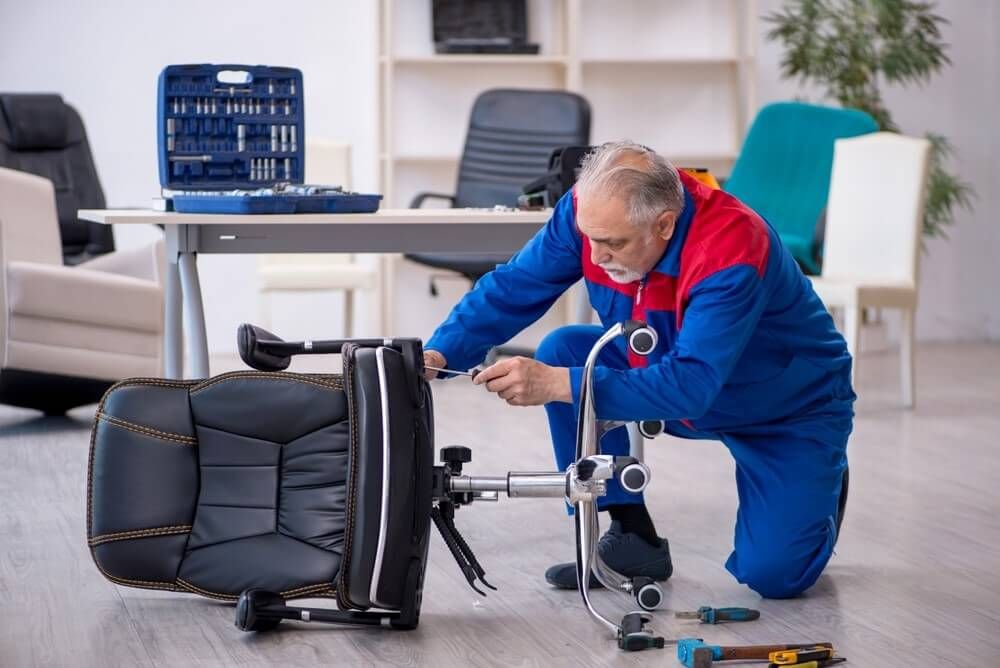
If your office chair won't stay raised, the cause is almost always a worn-out pneumatic gas cylinder - the sealed piston under the seat that holds your weight on a cushion of compressed gas. Once the seal leaks, no amount of fiddling with the height lever brings the chair back. The good news: you have two paths forward, and both cost less than $30.
This guide walks through the two consensus repairs (a $5 hose-clamp lock and a permanent cylinder swap), plus a $3 PVC-pipe shim that competitors at Desky and the Google AI Overview both recommend as the most durable DIY option. We've kept the steps short and the tool list honest - if you have a screwdriver and 15 minutes, you can fix this today.
Why your chair won't stay up
The cylinder under your seat is a sealed pressure system. A piston floats on compressed nitrogen; the height lever opens a valve that lets gas pass between two chambers, letting the seat rise or fall. When the seal at the top of the piston fails, gas leaks past it and gravity does the rest - your weight pushes the seat back down within seconds.
A few things accelerate seal failure:
- Weight load at or above the cylinder's rated limit (most economy chairs are rated 250 lb; premium task chairs 300-350 lb).
- Drop-sitting - letting your full weight slam down onto the seat instead of lowering into it.
- Age: typical office-chair cylinders last 5-8 years of daily use.
You can't refill the gas - the cylinder is sealed at the factory. Your only options are to bypass it (lock the seat at a fixed height) or replace it.
Tools you'll actually need
Hose-clamp lock: screwdriver or socket wrench, metal hose clamp (jubilee clip), duct tape.
PVC pipe shim: PVC pipe (1.5" inner diameter), hacksaw, utility knife.
Cylinder replacement: pipe wrench or rubber mallet, WD-40, replacement gas cylinder ($15-$30).
Most hardware stores carry all three options for under $30 combined.
Method 1: The hose clamp lock (5 minutes, ~$5)
The fastest fix. Locks the seat at one height permanently - adjust the chair to your preferred height before you start, because you won't be able to change it after.
- Raise the chair to your preferred height while it still goes up, or have someone lift the seat while you work.
- Slide the plastic cover (bellows) up the cylinder to expose the shiny metal piston underneath.
- Wrap 2-3 layers of duct tape around the exposed piston where you want the clamp to sit. The tape gives the clamp something to bite.
- Slide the metal hose clamp over the taped section, then tighten with a screwdriver or socket wrench until it grips the piston firmly and can't slide.
- Push the clamp down so it rests on the top of the wider base cylinder. It now acts as a physical stopper - the piston can't retract past it.
If the seat still creeps down after a day or two, the clamp loosened. Re-tighten and add another wrap of tape.
Method 2: The PVC pipe shim (15 minutes, ~$3)
More durable than the hose clamp and cleaner-looking. Same principle - physically blocks the piston from retracting - but uses a rigid pipe instead of a clamp.
- Measure the exposed piston at your preferred chair height.
- Cut a length of 1.5" inner-diameter PVC to match that measurement, using a hacksaw.
- Cut a slit lengthwise down the pipe with a utility knife so it can snap open.
- Snap the pipe over the piston between the seat plate and the wider base cylinder.
- Lower the chair onto the pipe. Your weight wedges the pipe in place; the seat can't drop below the pipe's height.
Cut multiple pipe lengths if you want a couple of fixed heights to switch between.
Method 3: Replace the gas cylinder (30 minutes, $15-$30)
The only fix that restores full adjustability. Replacement cylinders are standardized at 2.0" for almost every consumer office chair - measure the diameter of your existing piston before ordering to confirm.
- Turn the chair upside down on a soft surface.
- Spray WD-40 at both joints - where the cylinder meets the wheel base, and where it meets the seat plate. Let it soak for 5 minutes.
- Tap the cylinder firmly with a rubber mallet to break the friction fit at the seat plate. Twist and pull until it separates.
- Clamp a pipe wrench on the cylinder and rotate it free from the wheel base. Older cylinders sometimes need real force here - keep the chair stable.
- Insert the new cylinder into the wheel base (narrow end down).
- Lower the seat assembly onto the new cylinder and press your weight down. The taper-fit seats itself the first time you sit.
No bolts, no screws - the entire mechanism is held together by tapered friction fits. That's why a mallet and patience matter more than precision tools.

Should you fix it or buy a new chair?
A failing cylinder doesn't mean the chair is dead. The frame, padding, wheels, and tilt mechanism are usually still good. Repair makes sense when:
- The chair cost more than $200 originally.
- The padding and armrests are still in good shape.
- You like the chair and just need it to stop sinking.
Replace the chair when the cylinder is the third thing to fail (wheels gone, fabric torn, tilt mechanism broken). At that point you're patching a failing chassis.
A note on safety
Gas cylinders contain pressurized nitrogen, not compressed air or oil. They are not explosive under normal removal. The only failure mode worth caring about is the piston shooting upward if the cylinder is dismantled at the seal - don't try to cut it open, drill it, or pry the cap off. Replace, don't repair the cylinder itself.
Fix it yourself
- Costs $3-$30 instead of $200+ for a new chair
- Takes 5-30 minutes with basic hand tools
- Replacement gas cylinders are standardized at 2.0" across most consumer chairs
- Keeps a chair you already like - frame, padding, armrests stay the same
Replace the chair
- Hose-clamp and PVC shims lock the chair at one fixed height
- If the wheels, tilt mechanism, or padding are also failing, you're patching a dying chair
- Cylinder removal sometimes needs real force - a stuck cylinder can take 20 minutes of wrenching
- Older or off-brand chairs may use a non-standard cylinder diameter
Frequently asked questions
Can I refill the gas in my office chair cylinder?
No. Office chair cylinders are sealed at the factory and not designed to be refilled or recharged. The pressurized nitrogen inside can't be topped up through any consumer port. Once the seal fails, your only options are to lock the cylinder at a fixed height (hose clamp or PVC pipe) or replace the cylinder entirely.
How do I know what size replacement cylinder to buy?
Almost every consumer office chair uses a 2.0-inch (50mm) outer-diameter cylinder. Measure the wide base section of your existing cylinder before ordering to confirm. Length varies, but cylinders are sold with telescoping ranges that cover most chairs - pick one that brackets your desired seat-pan height.
Is it dangerous to remove an office chair gas cylinder?
Removal is safe. The cylinder contains pressurized nitrogen (inert, non-flammable), and the pressure is contained inside a sealed steel housing that doesn't release when you pull the cylinder out of the wheel base. The only thing to avoid is trying to cut, drill, or pry open the cylinder body itself - the contents are under pressure and not user-serviceable.
Why does my chair sink even though it's new?
Brand-new cylinders occasionally ship with a defective seal. If you're under the chair's weight rating and it's sinking within the first few weeks, contact the manufacturer for a warranty replacement before attempting any DIY fix - most office chairs carry a 1- to 5-year warranty on mechanical parts.
Will the hose-clamp fix damage my chair?
No. The clamp wraps around the exposed metal piston and doesn't touch the seat, the base, or the upholstery. If you ever decide to replace the cylinder properly, the clamp comes off in seconds with a screwdriver and the chair is none the worse for it.