
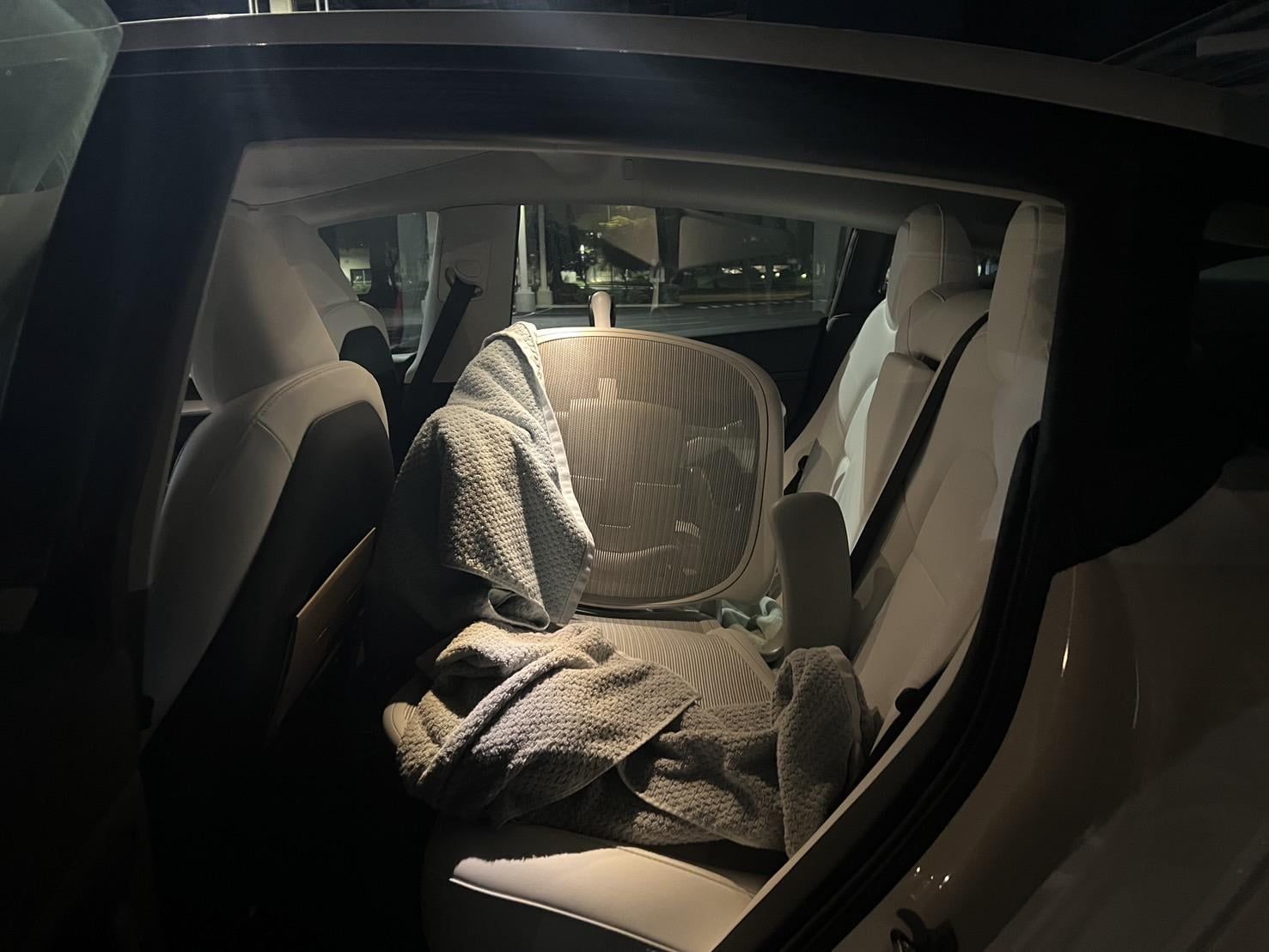
You found a deal on a Herman Miller chair on Facebook Marketplace, or you're moving a home office across town, and the question hits: will this thing actually fit in the car? In most cases the answer is yes - a standard task chair measures roughly 40 by 20 inches and slips into a sedan trunk or back seat with a little planning. The catch is which parts you remove, which direction you orient it, and what to do when the chair is bigger than the opening.
The short answer
Most office chairs fit in most cars. The base unscrews from the cylinder in one turn, the armrests pop off with two bolts, and the seat-back often detaches without tools. Once you separate the base from the seat, you've turned a 40-inch-tall chair into two flat-ish pieces under 25 inches each - small enough for almost any sedan trunk and easy on a back seat with the seats folded down.
The chairs that don't fit are the exception, not the rule: oversized executive thrones, gaming chairs with fused racing-bucket backs, and a few sealed-shell designs (the Steelcase Gesture's monoshell, for example) where you can't separate the back from the seat without tools.
Step 1: measure the chair
Measure assembled first, then estimate disassembled. You need three numbers, taken with the chair at its lowest gas-lift setting:
- Height - floor to the top of the headrest (or the top of the backrest if there's no headrest).
- Width - armrest to armrest at the widest point.
- Depth - front of the seat pan to the back of the backrest.
Typical numbers for a mid-size task chair land around 40 inches tall, 26 inches wide, and 26 inches deep. Once you pop the base, the seat-plus-backrest unit drops to roughly 30 by 26 by 20 inches and the five-star base is a flat 26-inch disc - both of which lie comfortably across a folded back seat.
Step 2: measure the car
Trunk-only transport is the harder case, so measure that first. Empty the trunk completely - spare tire cover, jack, cargo organizers, the lot. Then record:
- Trunk opening width (the bottleneck on coupes and small sedans).
- Trunk floor depth and width at the widest interior point.
- Trunk interior height from floor to closed lid.
If the disassembled chair beats the trunk on any single dimension, plan for back-seat or pass-through transport instead. Most sedans built after 2015 have a 60/40 split folding rear seat - use it.
Step 3: disassemble the right parts
Remove these (5 min, hand-tools)
- The five-star base - twist counter-clockwise where it meets the gas cylinder.
- Armrests - usually two bolts each, sometimes a single quick-release pin.
- Headrest - slides off the top of the backrest on most chairs that have one.
- Seat cushion - wing-screws or a snap-fit underneath.
Leave these alone
- The gas cylinder itself - it's pressurized and a pain to reinstall.
- The mechanism plate under the seat - proprietary fasteners, rarely needed.
- Mesh seat or backrest panels - risk of stretching or tearing if you flex them.
- Tilt-tension dials and recline knobs - leave them at their settings to save calibration time later.
Which cars handle which chairs
Rough guide for the most common pairings - assumes the chair is at least partially disassembled.
Compact sedans (Civic, Corolla, Mazda 3): Standard task chair fits with seats folded. The base goes in the trunk, the seat/backrest assembly rides across the folded back seat.
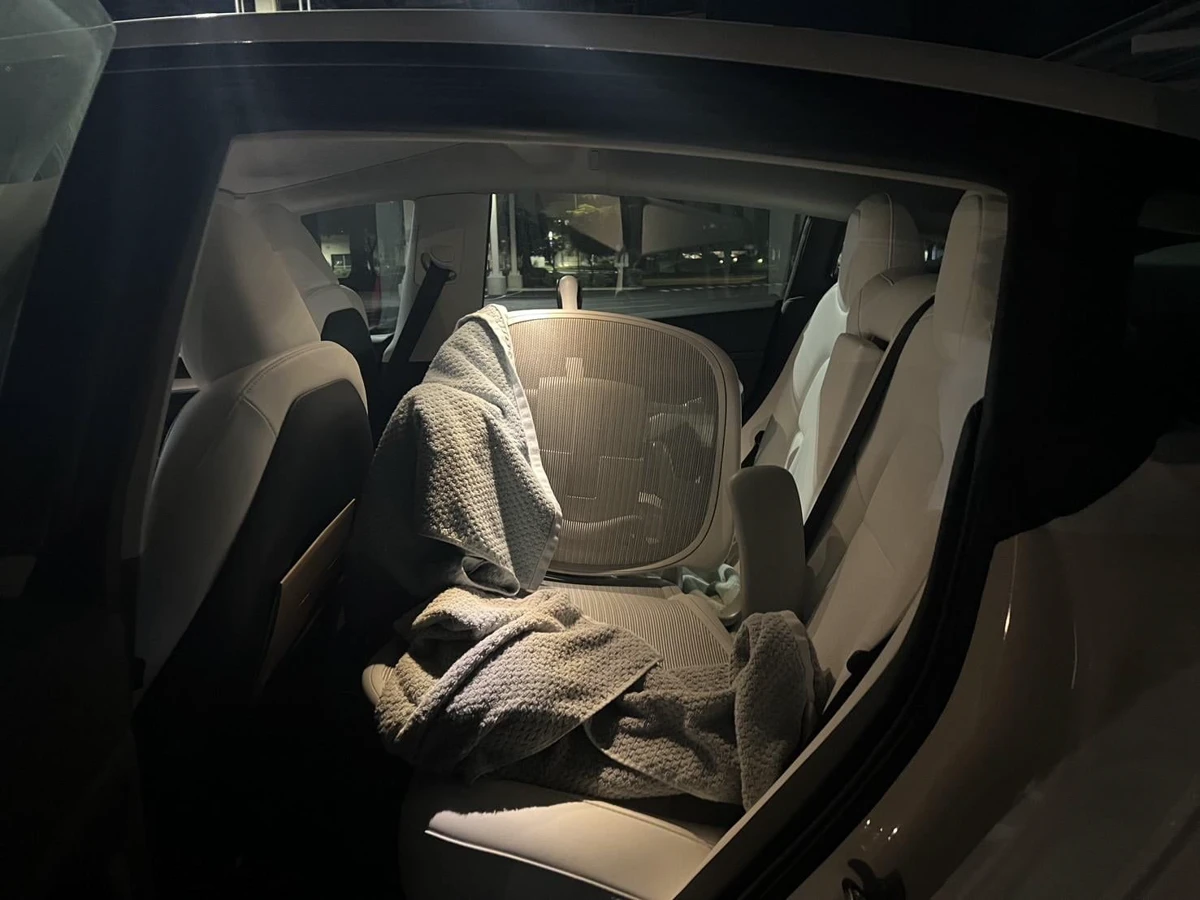
Mid-size sedans (Camry, Accord, Sonata): Same approach, easier execution. Many users report fitting an Aeron or Sayl assembled by laying it on its side across the back seat.
Hatchbacks and crossovers (Civic Hatch, CR-V, RAV4): Easiest case. Disassembly often optional. Lay the chair on its back and close the hatch.
Coupes (Mustang, Camaro, BRZ): Trunk opening is the limiting factor. Disassemble fully and plan for two trips if the chair is oversized.
Compact cars (Fit, Yaris, Mini): Workable but tight. Remove everything removable; ride the chair on the folded passenger seat if needed.
Loading order that actually works
- Lay an old blanket or moving pad across the seat or trunk floor - gas cylinders leak a film of oil and casters mark upholstery.
- Base in first, flat-side down. The five legs spread the weight.
- Seat-and-backrest assembly on top, mesh side up to avoid pressure on the lumbar curve.
- Loose parts (armrests, bolts, headrest) into a zipped bag and clipped to the chair so nothing rolls under the driver's seat.
When it still won't fit
A few fallbacks before you give up and rent a U-Haul:
- Roof transport - strap the disassembled chair to crossbars under a tarp. Works for short trips at moderate speed.
- Hitch cargo carrier - a 60-inch steel platform handles a fully assembled chair if you have a 1.25" or 2" receiver.
- Local delivery - Lugg, GoShare, and TaskRabbit drivers in most US metros will run a single piece across town for $40-$80.
- Original packaging - if the seller still has the manufacturer box, the chair returns to its factory dimensions, which is what the carton was sized for.
For trips over an hour, secure the load. A loose chair sliding around a trunk on highway curves will scratch interior plastics and may damage the chair's recline mechanism if it lands on a corner.
Frequently asked questions
Will a Herman Miller Aeron fit in a sedan?
Yes. The Aeron's base unscrews from the cylinder in one turn, and the seat/back assembly lays across a folded rear seat in any mid-size or compact sedan. Toyota Camry, Honda Accord, Mazda 3, and Subaru Impreza owners regularly report fitting an assembled Aeron by laying it on its side across the back seat without disassembly.
Do I need to disassemble the chair?
Not always. Hatchbacks, SUVs, and most mid-size sedans with folding rear seats can swallow an assembled task chair laid on its back or side. Disassembly is required for trunk-only transport in coupes and small sedans, and it makes loading easier in every other case.
How do I remove the base from an office chair?
Lay the chair on its side, hold the cylinder steady, and rotate the five-star base counter-clockwise (looking down). The base threads off in two or three turns. If it won't budge, tap the underside of the base with a rubber mallet to break it loose - gas cylinders are tapered fittings and seize over time.
Can I leave the office chair in my car overnight?
Short term, yes. For longer storage, avoid leaving a chair in a hot car for days - high cabin temperatures can soften foam, dry out leather, and accelerate plastic creep on the recline mechanism. Mesh chairs handle heat better than padded ones.
What's the best way to protect the upholstery during transport?
A moving pad or thick blanket under the chair protects both your car's seats and the chair itself. Cover mesh and leather surfaces with a second cloth to prevent scuffs from loose hardware. Tape any bolts and small parts to the chair or zip them into a labeled bag.
Bottom line
Almost any office chair fits in almost any car if you take five minutes with a screwdriver. Measure both ends before you drive across town to pick up a Marketplace deal, bring a blanket, and pack a small bag for the loose hardware. The chairs that fight you are the exceptions - and even those usually surrender to a folded back seat and a little patience.