
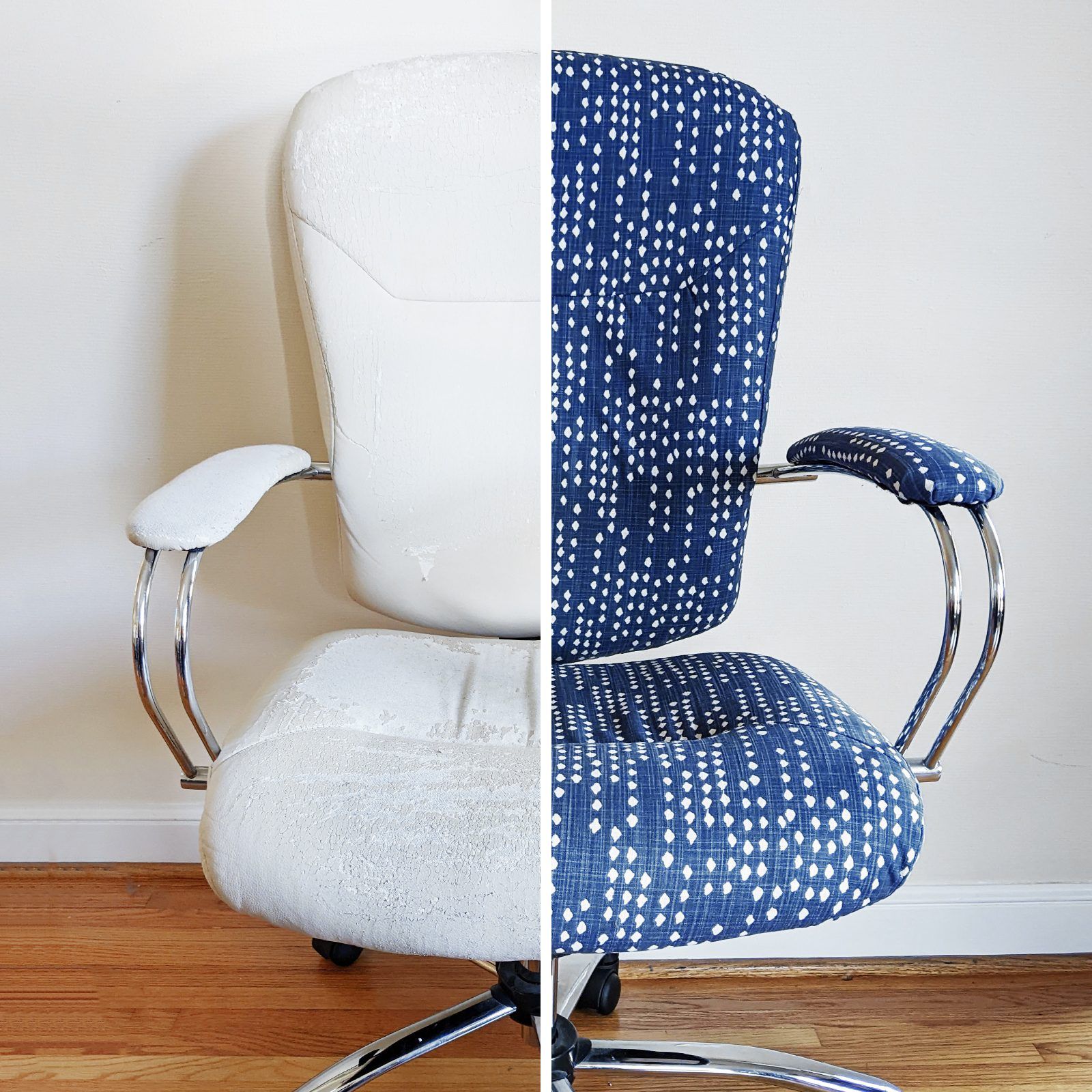
A standard task chair does its job, but it rarely matches the rest of the room. The good news: you can transform a plain office chair into something that fits your space without giving up ergonomics, and most of the methods below cost less than $40 and take an afternoon.
This guide walks through seven decorating approaches - ordered from no-commitment to full-makeover - followed by a step-by-step reupholster tutorial for the chairs whose factory fabric has to go.
7 Ways to Decorate an Office Chair
1. Stretch slipcovers
The fastest and most reversible upgrade. A stretch dining-chair or office-chair slipcover (widely available on Amazon for around $14) pulls over the seat and back of a standard task chair, hides worn or corporate-black fabric, and machine-washes when it gets grubby. Patterns range from solid linens to celestial, boho, and retro prints.
Best for: rentals, shared workspaces, or anyone who isn't ready to commit to a permanent change.
2. A draped throw or faux-fur rug
Fold a throw blanket - or even a small faux-fur rug - over the backrest and let it spill over the seat. It softens the harsh lines of a task chair, adds warmth on cold mornings, and takes about 10 seconds to undo. Designers at A Beautiful Mess note this is one of the most-used tricks for warming up an otherwise utilitarian chair.
Best for: quick seasonal swaps; styling for video calls.
3. Decorative lumbar and seat pillows
A memory-foam lumbar pillow in velvet, floral, or geometric fabric serves two jobs at once: it props up the small of your back and injects color. Look for one with an adjustable strap so it stays put when you wheel around. A coordinating seat cushion can match the lumbar for a built-in look.
Best for: anyone whose chair lacks adjustable lumbar support out of the box.
4. Mesh-back embroidery
If your chair has a mesh back, you can cross-stitch directly through the holes with embroidery floss and a tapestry needle - no damage to the mesh, fully reversible, and the result is genuinely one-of-a-kind. The technique started circulating on TikTok in 2023 and works for simple shapes (hearts, plants, geometric blocks) up through detailed scenes if you have the patience.
Best for: Herman Miller-style mesh chairs and other breathable-back designs.
5. Side accessories and clip-ons
Functional decor: clip a fabric organizer or small clipboard to the armrest for notes, hang a faux succulent or air plant from the underside, or wrap a leather strap around the armrest as a magazine sling. Each piece adds personality without touching the chair's surface.
Best for: people who want decor that also earns its keep.
6. Spray-paint the frame
The base, arms, and wheel tops of most office chairs are bare metal or plastic and take spray paint well - provided you prime first. Gold, matte black, and brass are popular swaps for the default silver. Mask the gas-lift shaft (it's intentionally oily and needs to stay that way to move), and ventilate properly.
Best for: chairs where the seat is fine but the frame screams "office-supply catalog."
7. Full fabric reupholster
The most labor-intensive option and the most transformative. You disassemble the chair, recover the seat and back with the fabric of your choice, then reassemble. Step-by-step below.
Best for: chairs where you love the shape and the ergonomics but hate the fabric.
Step-by-Step: Reupholster an Office Chair
This is the long-form version of option 7. Allow 2-3 hours start to finish for a basic task chair.
What you'll need
- Fabric: 2 yards of medium-weight upholstery fabric (cotton duck, linen, faux fur, velvet) for a standard chair; 3 yards for a tall back.
- Tools: Phillips screwdriver, staple gun with 1/4" or 3/8" staples, fabric scissors, pins, optional curved upholstery needle and thread for tacking puffy spots.
- Optional: spray primer + spray paint if you also want to refinish the legs.
Step 1: Disassemble the chair
Tip the chair on its side and locate the screws joining the armrests, backrest, and seat to the central column. Remove the armrests and backrest first, then unscrew the seat from the gas-lift mechanism. Keep all hardware in a labeled cup so reassembly is straightforward - refer to your chair's manual if anything looks proprietary.
Step 2: Pry off the plastic trim
Most seat pans have a plastic cover hiding the staples that hold the original fabric. Slip a putty knife under the edge and lift it off. Set it aside - you'll re-snap it on at the end.
Step 3: Cut your new fabric to size
Lay the seat upside-down on the back of your new fabric and trace around it, adding 3 to 4 inches of overhang on every side. That overhang wraps around the bottom and gets stapled. Repeat for the backrest. If your fabric has a pattern, double-check the direction before cutting - fur, especially, has a "right way up."
Step 4: Drape and pin
Place the new fabric over the seat, smooth it from the center outward, and pull each side taut underneath. Pin the corners first so you can adjust without committing. Stretch evenly - you want the fabric tight enough that it won't wrinkle when you sit, but not so tight that it puckers at the corners.
Step 5: Staple in place
Working from the center of each side outward, drive staples every 1-1.5 inches into the underside of the seat pan. Do the long sides first, then the short sides, then the corners - fold the fabric like wrapping a gift to keep the corners flat. Trim excess to about a half-inch beyond the staple line.
For the backrest, follow the same approach. If the back is molded plastic that doesn't take staples, pry the plastic shell off the cushioned front (it usually snaps), wrap the cushion, then snap the shell back on.
Step 6: Reassemble
Re-snap the plastic trim covers over your staple lines, screw the seat back onto the gas lift, then reattach the backrest and armrests in reverse of the order you removed them. Spin the chair upright and check the fit - small puffy spots can be tacked down with a curved upholstery needle.
Step 7: Style it in
Roll the chair into position and add any of the lighter touches above - a lumbar pillow, a throw across the backrest, a clip-on plant - to complete the look.
Quick Comparison: Which Method Should You Pick?
Fastest (under 5 minutes): stretch slipcover, draped throw, lumbar pillow.
Most personal: mesh embroidery, full reupholster.
Cheapest: draped throw if you already own one; stretch slipcover (~$14) if you don't.
Most reversible: slipcover, throw, pillow, clip-on accessories.
Most permanent: spray-paint the frame, full reupholster.
A combination usually looks best. A reupholstered seat, a painted base, and a small clip-on plant together read as intentional - any one of them alone reads as a hack.
Office chair decorating FAQ
How do I make an office chair look nicer without permanently changing it?
A stretch slipcover ($10-$20 on Amazon), a draped throw, and a decorative lumbar pillow are the three fastest reversible upgrades. All three together completely transform the look in under five minutes and leave the chair underneath untouched.
Can you reupholster an office chair without sewing?
Yes. The most common approach uses a staple gun on the underside of the seat pan - no sewing required for a basic flat-seat chair. Sewing is only needed for sculpted backs (like a curved executive chair) where the fabric has to follow a 3D shape.
How much fabric do I need to reupholster an office chair?
About 2 yards of medium-weight upholstery fabric covers a standard task chair seat and back. A tall executive back or a curved sculpted back needs closer to 3 yards. Buy a half-yard extra for mistakes - fabric stores rarely match dye lots on a second trip.
Can I spray-paint an office chair?
The metal and rigid plastic parts of the frame take spray paint well if you prime first. Do not paint the gas-lift cylinder (the shiny shaft that lets the chair go up and down) - it is intentionally oily and needs to stay smooth. Mask it off and work in a well-ventilated area.
Will decorating my office chair void the warranty?
Slipcovers, pillows, throws, and clip-on accessories do not void any warranty - none of them modify the chair. Spray painting the frame and reupholstering the seat will generally void cosmetic and material warranties from major manufacturers (Herman Miller, Steelcase). Structural and mechanism warranties usually still apply.