

Short answer: yes - and more often than people realize. When patients walk into my clinic with calf cramps, numb thighs, or burning behind the knees that only show up on weekdays, the culprit is rarely the legs themselves. It's the eight hours they spent in a chair that's the wrong height, the wrong depth, or missing the support their pelvis needs.
A poorly fitted office chair compresses blood vessels behind the thighs, shortens the hip flexors, and tilts the pelvis backward - and the legs are downstream of all three. Below is the diagnostic checklist I use with seated workers, the specific measurements that matter, and the fixes that resolve most cases in under two weeks.
How a chair causes pain that shows up in your legs
Three mechanisms account for the majority of chair-driven leg pain:
- Vascular compression. A seat pan that's too deep or too high presses the popliteal vein at the back of the knee, slowing venous return. The result is heavy, achy calves by mid-afternoon and visible swelling around the socks.
- Nerve impingement. A flat seat with no waterfall edge, plus a posterior pelvic tilt from poor lumbar support, can irritate the sciatic and posterior cutaneous femoral nerves. Patients describe it as a hot, electric line running from the buttock down the hamstring.
- Muscle shortening. Sitting for 8+ hours holds the hip flexors at roughly half their resting length. Over weeks, they remodel short. That's why your first steps after standing up feel stiff, and why your stride shortens by the end of the week.
The five chair problems that produce leg pain
1. Seat pan too deep (the most common cause)
If you can't slide two to three fingers between the front edge of the seat and the back of your knee, the pan is too deep. The edge digs into the popliteal fossa, compresses the vein, and forces you to either slouch (to reach the backrest) or perch on the front (losing lumbar support). Either way, the legs lose.
Fix: slide the seat pan forward if your chair has a depth adjustment. If not, add a firm lumbar cushion behind your back to functionally shorten the pan by 2-3 inches.
2. Seat height wrong by more than half an inch
The target is feet flat on the floor with hips 1-2 inches higher than knees - a knee angle of roughly 100-110 degrees, not 90. Too high and the chair cuts circulation behind the thighs; too low and you compress the hip joint and lock the glutes. Most adjustable chairs have a 4-6 inch range; measure from the floor to the back of your knee while standing - that's your starting cylinder height.
3. Flat seat with no waterfall edge
A waterfall edge - the gentle downward curve at the front of the seat - is the single feature that distinguishes a chair built for 8-hour sitting from a chair built for a 45-minute meeting. Without it, the front edge becomes a tourniquet on the back of the thighs. If your chair lacks one, a 2-inch memory foam seat pad with a beveled front is the cheapest meaningful fix.
4. No lumbar support (or lumbar set too low)
When the lumbar curve isn't supported, the pelvis rolls back, the lower spine flattens, and the load travels down through the sciatic nerve. The lumbar pad should sit at belt-line - roughly 6-10 inches above the seat, not at the small of the back near the rib cage.
5. Armrests too high
Less obviously, armrests set above elbow height shrug the shoulders and tilt the torso back, which unweights the hips and shifts pressure onto the back of the thighs. Drop the armrests until your elbows rest at roughly 90 degrees with shoulders relaxed.
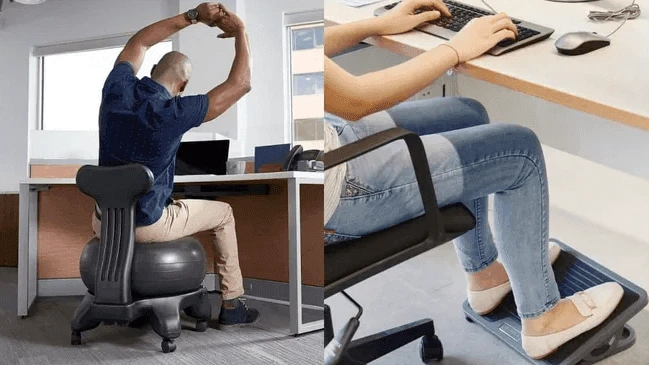
Five signs your chair is the problem (not your legs)
- Pain pattern is workday-shaped. Symptoms worsen by 3pm, peak by 6pm, and resolve overnight or on weekends. Vascular and postural causes track the clock; injury-driven pain does not.
- Sock indentations by end of day. Visible swelling at the ankle that wasn't there in the morning points to compromised venous return from the chair, not the legs.
- Burning or pins-and-needles down the back of one thigh. Classic for seat-edge pressure on the sciatic or posterior cutaneous femoral nerve - almost always one side, the side you cross your legs toward.
- Stiff first steps after standing. Hip flexor shortening. If you have to walk it off for the first 30 seconds, the chair is winning.
- Restless legs at night on weekdays only. Daytime venous pooling shows up as evening discomfort. Weekend recovery confirms the pattern.
The 10-minute chair fit protocol
Run this once. Most people get noticeable relief within 5-7 working days.
- Sit all the way back. Hips should touch the backrest before you do anything else.
- Adjust seat height so feet are flat and hips are 1-2 inches above knees (not level).
- Adjust seat depth to leave a 2-3 finger gap behind the knees.
- Position lumbar support at belt-line. If the chair's lumbar is fixed and feels wrong, override it with a portable lumbar roll.
- Drop armrests until shoulders fully relax and elbows rest at ~90 degrees.
- Set a 50/10 rule: every 50 minutes, 10 seconds of standing and a hip-flexor stretch.
Frequently asked questions
Can a bad office chair really cause sciatica?
It can trigger sciatic-pattern symptoms - burning down the back of one leg - through prolonged pressure on the nerve and a posterior pelvic tilt that compresses lumbar discs. True sciatica from a herniated disc is separate, but chair-driven nerve irritation mimics it closely. If symptoms persist on weekends or include weakness, see a clinician.
How long does it take for leg pain to improve after fixing the chair?
In most patients I see, vascular symptoms (swelling, heavy calves) improve within 3-5 days of correcting seat depth and height. Nerve-pattern symptoms take 1-3 weeks. Muscle-shortening stiffness improves over 2-6 weeks paired with daily hip-flexor stretching.
Is a standing desk a better fix than a new chair?
Standing is not the opposite of sitting - it's another static posture. The fix is movement, not standing. A standing desk used in 30-45 minute intervals alongside a well-fitted chair outperforms either alone.
Does an expensive ergonomic chair guarantee no leg pain?
No. A $1,200 chair set up wrong will hurt you faster than a $200 chair set up right, because the adjustments are heavier and the wrong settings are more rigidly held. Fit beats price. Always.
Should I see a doctor for leg pain from sitting?
Yes, if you have: pain that doesn't improve overnight, unilateral swelling without obvious cause, calf pain with warmth or redness (rule out DVT), or any numbness with weakness. Chair-driven pain follows a workday rhythm; medical causes do not.